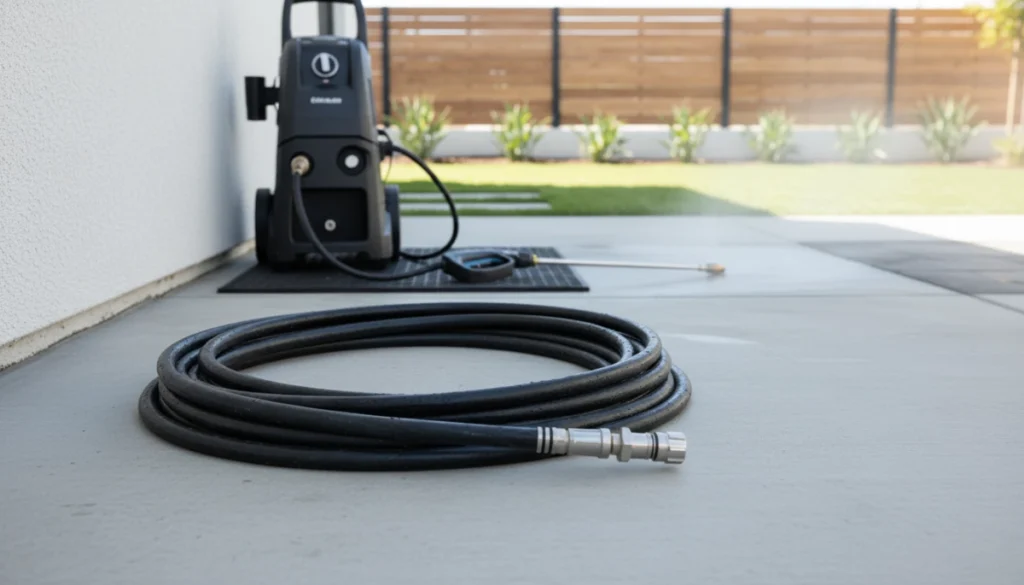
A pressure washing hose is a composite tool engineered to withstand extreme hydraulic stress, not just a simple rubber tube. At our factory, we approach hose construction as a precise science, ensuring every layer contributes to the overall structural integrity and ISO9001 compliance. We understand that for industrial applications, the internal composition determines the lifespan and safety of the equipment.
The Inner Tube: Chemical Resistance and Mineral Defense
The core of our hoses features high-grade materials like Rubber NBR and odorless PVC, designed specifically for fluid compatibility. This inner layer is the first line of defense against aggressive cleaning detergents and mineral deposits found in hard water.
Chemical Stability: Our NBR formulations resist degradation from soaps and solvents used in car washing.
Smooth Bore Engineering: We manufacture the inner tube with a flawless surface finish to maintain optimal flow rates and prevent pressure drops.
Temperature Tolerance: Capable of handling high-temperature fluids without softening or deforming.
The Reinforcement Layer: Textile vs. High-Tensile Wire Braiding
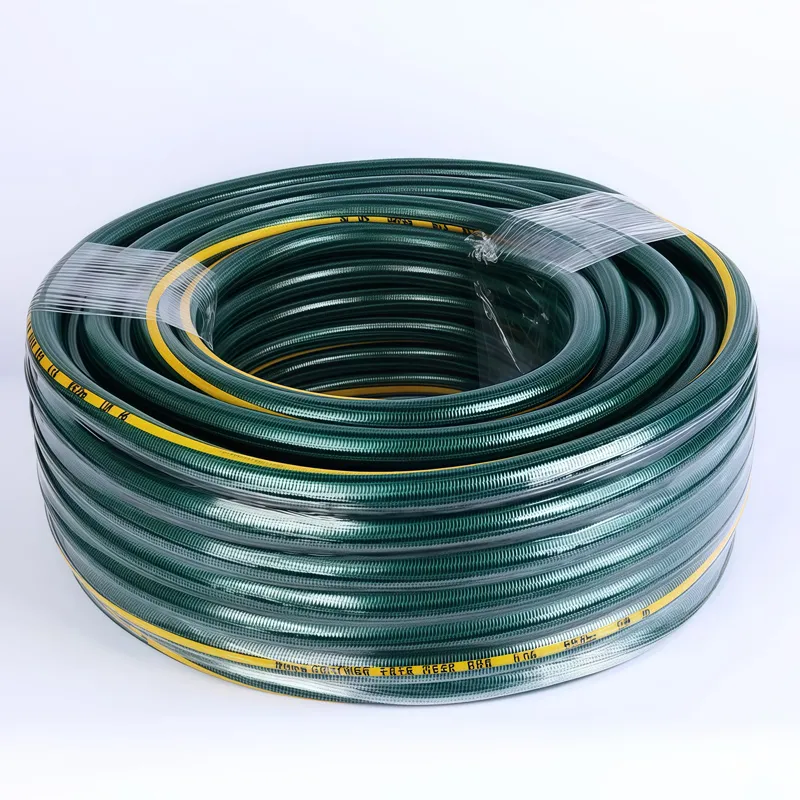
To achieve industrial-grade performance, such as our 500 PSI rated models, the reinforcement layer is critical. We utilize advanced manufacturing techniques, including reticulated and crochet designs, to bind the inner and outer layers.
Burst Pressure Safety: The reinforcement matrix prevents the hose from expanding or bursting under load.
Flexibility Retention: Unlike rigid pipes, our braided structure allows for a tight bend radius without kinking.
Structural Integrity: This layer absorbs the mechanical stress, ensuring the pressure washing hose remains stable during operation.
The Outer Jacket: Abrasion Resistance and Non-Marking Tech
The external layer is built to survive harsh job site environments. We engineer our outer jackets using weather-resistant PVC and rubber blends that offer abrasion resistance against concrete, asphalt, and gravel.
Non-Marking Properties: Essential for auto-detailing, our jackets are designed to leave no residue on surfaces.
Weather Resilience: Our “Antifreeze” and cold-proof technology ensures the hose remains flexible and crack-resistant even in freezing conditions.
UV Protection: The outer shell shields the reinforcement layers from sun damage, prolonging the service life of the hose.
Material Science: Rubber NBR vs. PVC vs. Thermoplastic
Choosing the right pressure washing hose material isn’t just about price; it is about matching the tool to the job. As a manufacturer, we see firsthand how different compounds perform under stress. Whether you are stocking for heavy industrial use or residential car detailing, understanding the Thermoplastic vs. Rubber NBR debate is critical for customer satisfaction.
PVC: Lightweight, Economical, yet Stiff
Polyvinyl Chloride (PVC) is the most common material for entry-level hoses. It is lightweight and cost-effective, making it attractive for homeowners. However, standard PVC can be stiff and difficult to maneuver, especially in colder temperatures where it becomes prone to kinking.
Pros: Affordable, lightweight, easy to clean.
Cons: High “memory” (retains coil shape), stiff in cold weather.
Best For: Occasional residential cleaning and electric pressure washers.
We produce specialized white PVC garden hoses for home car washing that improve upon standard designs with better flexibility and a cleaner aesthetic for patio and vehicle maintenance.
Rubber NBR: The Heavy-Duty Professional Gold Standard
For industrial applications, Rubber NBR (Nitrile Butadiene Rubber) is the superior choice. Our factory produces industrial-grade NBR hoses rated for pressures up to 500 PSI. Unlike PVC, rubber offers exceptional oil resistance and high-temperature tolerance, making it essential for hot water pressure washers.
Durability: Withstands dragging over concrete and rough terrain.
Flexibility: Lays flat and resists kinking, even in freezing conditions.
Performance: These are true weather-resistant hose materials designed for longevity.
Thermoplastic Hybrid: Balancing Flexibility and Weight
The flexible hybrid polymer hose blends the durability of rubber with the lightweight properties of PVC. This material is rapidly gaining popularity among professional detailers who need to move quickly around vehicles without fighting a heavy hose. It offers significant abrasion resistance without the bulk of traditional rubber, striking a balance for users who need performance without the weight.
Critical Specs: Matching the Hose to the Machine
Pressure Ratings: PSI, Burst Pressure, and Safety Factors
Selecting the correct pressure washing hose starts with the numbers. You cannot simply grab any tube off the shelf; the maximum PSI rating must align with your machine’s output to ensure safety and performance. At our factory, we manufacture industrial-grade rubber NBR hoses capable of handling up to 500 PSI, designed specifically for high-pressure fluid transmission.
Beyond the working pressure, we emphasize the burst pressure safety factor. This is the buffer zone that prevents the hose from rupturing during pressure spikes. A quality hose is engineered to withstand pressures significantly higher than its rated operating limit, providing peace of mind during intensive operation.
Diameter Dynamics: 1/4 Inch vs. 3/8 Inch Flow Rates
The internal width of your hose dictates the volume of water that reaches the surface.
1/4 Inch: Ideal for consumer-grade electric washers. It is lightweight and easy to maneuver but restricts flow.
3/8 Inch: The standard for professional gas units. This larger diameter supports higher Gallons Per Minute (GPM), allowing for faster cleaning.
Understanding flow restriction is vital. Just as you might look for ways on how to increase garden hose water pressure fast and effectively for general irrigation, choosing the right 3/8 inch vs 1/4 inch diameter is the quickest way to maximize your pressure washer’s efficiency.
Temperature Tolerance: Handling Hot Water and Freezing Conditions
Environmental resilience is a hallmark of our manufacturing process. Standard hoses often fail when exposed to temperature extremes. We utilize weather-resistant hose materials to combat this.
Hot Water: For industrial degreasing, you need high temperature resistant rubber (NBR) that won’t soften or burst under heat.
Cold Weather: Our antifreeze PVC and rubber blends prevent the hose from becoming brittle and cracking in freezing temperatures.
Whether you require cold water vs. hot water capability, ensuring your hose matches the environment is as critical as matching the PSI.
Solving the Fitting Puzzle: M22 and Quick Connects
Connecting a pressure washing hose shouldn’t be a guessing game, yet compatibility issues are the number one reason for leaks and pressure loss. As a manufacturer, we know that precision in machining makes the difference between a watertight seal and a messy workspace. Whether you are stocking inventory for homeowners or professional detailers, understanding these connection standards is non-negotiable.
The Leak Culprit: M22-14mm vs. M22-15mm Explained
The industry standard for many electric and gas units is the M22 threaded connection, but there is a hidden variable that often trips up buyers: the inner stem diameter.
M22-14mm: This is the most common standard. The inner pin is 14mm wide.
M22-15mm: Often found on specific electric pressure washer brands. The inner pin is 15mm wide.
If you try to connect a M22 14mm vs 15mm fitting incorrectly, the rubber O-ring won’t seat properly. A 14mm plug in a 15mm socket causes a massive leak, while the reverse often won’t fit at all. When pairing a high-performance PVC garden or car wash hose with a machine, verifying this internal dimension is critical to ensure the O-ring seals tight against the high-pressure fluid.
Quick Connects: The Standard for Rapid Setup
For professional applications, threading a hose on and off every day is inefficient. The industry is moving heavily toward the quick connect coupler system, typically in 3/8-inch sizes for the hose inlet and outlet.
Efficiency: Snap-on mechanisms allow for instant switching between different spray guns or foam cannons.
Durability: Reduces wear on the threads of the pump and the hose.
Rotation: Many quick connects allow the hose to swivel freely, reducing kinks during operation.
Custom OEM Fitting Solutions for Brand Owners
One size rarely fits all in the global market. As a factory-direct supplier, we offer OEM pressure washer accessories and fitting customization for wholesalers and brand owners. We don’t just supply the hose; we engineer the termination points to match your specific market requirements.
Our OEM services cover:
Custom Crimping: Installing specific M22 or Quick Connect fittings directly at the factory.
Material Selection: Options for brass, stainless steel, or plated aluminum fittings based on cost and durability needs.
Market Adaptation: Producing batches specifically with 14mm or 15mm standards to suit local machine popularity.
By controlling the manufacturing process, we ensure that every pressure washing hose leaving our facility meets strict ISO9001 tolerances, eliminating the headache of mismatched fittings for your end customers.
Durability Factors: Why Cheap Hoses Fail
In the industrial cleaning world, a pressure washing hose is only as good as its weakest point. We see generic hoses fail constantly because they cut corners on the reinforcement layer or use low-grade fillers in the jacket. A professional hose needs to withstand dragging over concrete, high-pressure spikes, and constant coiling without delaminating. If the bonding between the inner tube and the outer cover isn’t solid, the hose will bubble and burst under load.
Kink Resistance: Overcoming Hose Memory
There is nothing more frustrating than fighting a hose that wants to stay coiled. This “hose memory” is a sign of poor material quality. We utilize specific braiding techniques—often referred to as a “snake” skin or reticulated structure—to ensure the hose lays flat during use. Kink-resistant technology isn’t just about convenience; a kink creates a weak spot where pressure builds up, leading to blowouts. Understanding the structural differences in reinforced PVC versus rubber hoses helps in selecting a product that maintains flexibility without sacrificing the strength needed for high-pressure applications.
Weather Resilience: UV Protection and Cold-Cracking
Outdoor equipment faces brutal conditions. Standard plastics turn brittle under UV exposure, leading to cracks that leak. Furthermore, when temperatures drop, inferior materials stiffen and snap. Our manufacturing process incorporates weather-resistant hose materials designed to be “antifreeze” and cold-proof. Whether it is scorching sun or near-freezing wash bays, the hose must remain pliable. We use specialized NBR and high-grade PVC blends to ensure the outer jacket resists abrasion and environmental stress simultaneously.
The Role of ISO9001 Standards in Consistency
Reliability comes from strict process control. As a factory, adhering to ISO9001 quality standards means every batch of hose is tested to the same rigorous benchmarks. We don’t just guess at the burst pressure safety factor; we verify it. This certification ensures that the wall thickness is uniform, the reinforcement braiding is consistent, and the chemical resistance meets international requirements. For retailers and wholesalers, this eliminates the risk of fluctuating quality between shipments.
Sourcing Guide for Retailers and Wholesalers
As a manufacturer, I know that building a profitable inventory requires understanding exactly who is using the equipment. A generic approach rarely works in the global market. You need to segment your stock based on the specific demands of your end-users, ensuring you have the right pressure washing hose for every application.
Inventory Checklist: Stocking for Auto-Detailers vs. Construction
The requirements for a professional car detailer are vastly different from a construction contractor. When planning your procurement, consider these distinct categories:
For Auto-Detailers: These professionals prioritize maneuverability and surface protection. You should stock hoses featuring a non-marking outer jacket to ensure the hose doesn’t leave scuffs on vehicle paint or driveway surfaces. They often prefer a flexible hybrid polymer or a specialized car wash water hose that resists kinking and is lightweight enough to drag around tires without fatigue.
For Construction & Industrial Use: Durability is the only metric that matters here. Your inventory must include heavy-duty options with steel braided reinforcement. These users need a high-pressure replacement hose capable of withstanding dragging over rough concrete, sharp debris, and high PSI loads without bursting.
The Factory-Direct Advantage: Customization and Lead Times
Sourcing directly from the factory eliminates the middleman, giving you control over both product specs and profit margins. We provide full support for OEM pressure washer accessories, allowing brand owners to customize everything from the hose color and material composition to the retail packaging.
Customization: Whether you need specific quick connect coupler sets pre-installed or unique branding on the jacket, our OEM/ODM services cover it.
Quality Consistency: We adhere to strict ISO9001 quality standards. This ensures that every batch you receive meets the same burst pressure safety factors, reducing returns and warranty claims.
Reliable Lead Times: With 24/7 support and scalable production lines, we manage large-scale orders efficiently, ensuring your supply chain remains uninterrupted during peak seasons.
Frequently Asked Questions (FAQ)
As a manufacturer dealing with global distributors and brand owners, we encounter these technical questions daily. Here is the breakdown of what you need to know about pressure washing hose specifications.
Are all pressure washer hoses universal?
No, they are not. While many hoses look similar, the connections and pressure ratings vary significantly. The most common compatibility issue lies in the fittings.
Connection Type: Most residential units use M22 threaded connections or a quick connect coupler.
Internal Diameter: The inner pin size matters. The M22 14mm vs 15mm fitting distinction is critical; using a 14mm plug in a 15mm socket will cause leaks.
Pressure Rating: You must match the hose’s maximum PSI rating to your machine. Using a lower-rated hose on a high-pressure machine is a safety hazard.
What is the difference between 1-wire and 2-wire braided hoses?
The difference lies in the steel braided reinforcement layer inside the rubber jacket. This impacts both durability and flexibility.
1-Wire: Contains a single layer of high-tensile steel wire. It is lighter and more flexible, making it ideal for standard consumer applications.
2-Wire: Features two layers of steel braiding. This design offers a higher burst pressure safety factor and is built for heavy-duty industrial use where abrasion resistance is key.
Can I use a hot water hose on a cold water machine?
Yes, absolutely. A hose rated for hot water—typically made from high-temperature resistant rubber NBR—can easily handle cold water applications. However, the reverse is not true. You cannot use a standard cold-water thermoplastic hose with a hot water machine, as the high heat will soften the inner tube, leading to failure or bursting. For those managing different setups, understanding flow rates and pressure helps in selecting a versatile hose that maintains performance across different temperatures.
How do I measure my pressure washer fitting size?
To ensure you order the correct OEM pressure washer accessories, precise measurement is required.
Check the Thread: Measure the outer diameter of the male thread (usually 22mm for M22 fittings).
Measure the Inner Spigot: Use calipers to measure the inner tip of the male fitting. If it measures 14mm, you need an M22-14mm hose. If it measures 15mm, you need the M22-15mm version.
Consult the Factory: For bulk orders, we provide custom fitting solutions to ensure your inventory matches the specific machines popular in your local market.
When cleaning the outside of your home such as driveways, patios, and decks, homeowners often wonder whether to use a regular garden hose or a power washing . Both can remove dirt, but they differ greatly in how efficient and effective they are, as well as in the effort required. Knowing these differences helps you […]
Learn what garden hose flow rate means, how to work it out, and what affects it in everyday use. This will help you choose the right flow rate for your irrigation setup and for regular garden watering. What is garden hose flow rate? Garden hose flow rate means how much water moves through a hose […]
When it comes to outdoor activities, particularly gardening, having the right tools can make all the difference. One tool that often gets overlooked but is absolutely essential is the PVC Water Hose . You may not realize it, but the quality and durability of your water hose can significantly impact the ease and efficiency of […]
We use cookies to enhance your browsing experience, serve personalised ads or content, and analyse our traffic. By clicking "Accept All", you consent to our use of cookies.